
How Visual Tracking Exercises Improve Stability

Updated: Aug 4
Try this for a second. Stand up, pick a spot on the wall, and slowly turn your head from side to side while keeping your eyes locked on that spot. Feels pretty easy, right? Now imagine doing that same thing while walking down a busy hallway, or turning to check for cars before crossing the street. Suddenly your eyes, your inner ear, and your legs all have to agree on where "up" is, and they have to agree fast.
That teamwork between your eyes and your sense of balance is a bigger deal than most people realize. And it turns out that training your eyes on purpose, through what's called visual tracking exercises, can genuinely help you feel steadier on your feet.
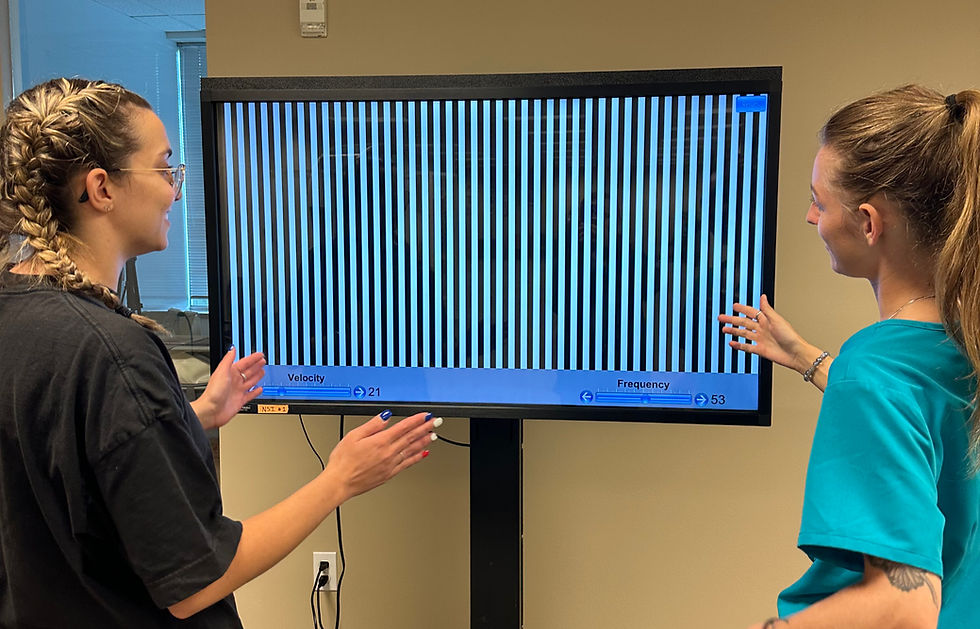
Your eyes are part of your balance system, not just your vision
We tend to think of eyesight and balance as two completely separate things. One lets you see, the other keeps you upright. But your brain doesn't really separate them that cleanly. Your eyes send a constant stream of information about where things are around you, and your inner ear sends information about how your head is moving through space. Your brain blends those two signals together, along with feedback from your joints and muscles, to figure out how to keep you standing.
When that blending works well, you barely notice it happening. When it's a little off, from a head injury, an inner ear issue, or just a nervous system that's out of practice, you might feel dizzy in busy places, unsteady when you turn quickly, or strangely tired after looking at a screen for too long.
What visual tracking exercises actually do
Visual tracking exercises are simple drills that train your eyes to move smoothly and accurately, often while your head or body is also moving. Think following a swinging ball with your eyes while standing on one foot, or shifting your gaze quickly between two targets while your head stays still. Some versions add motion, like turning your head side to side while keeping your eyes fixed on a single point.
The reasoning behind these drills is well supported. As one detailed overview of gaze stabilization training explains, simple eye movement exercises have been shown to improve both standing balance and confidence in movement, even in older adults, and researchers have found these gains hold up in structured studies over time. In plain terms, when you practice keeping your gaze locked on something while your head or body moves, you're rehearsing the exact coordination your brain needs to keep you upright out in the real world.
This lines up with what we already know about the broader picture of stability. Balance rarely comes down to one single system working alone, it depends on several body systems, including vision, staying in sync, which is exactly why training the eyes can make such a noticeable difference in how someone moves.
Why this matters beyond the eye doctor's office
People often assume vision training only matters for reading or screen time. But the eyes are doing constant, split-second work every time you walk through a doorway, step off a curb, or glance over your shoulder while merging into traffic. If your eyes are slow to lock onto a target, or if your gaze drifts when your head turns, your brain has to work harder to figure out where you are in space. That extra effort can show up as clumsiness, a wobble, or a general sense of not trusting your own footing.
This is especially true for anyone recovering from a concussion, dealing with chronic dizziness, or simply noticing that their balance isn't what it used to be. Training the eyes to track smoothly again often takes pressure off the rest of the balance system, so walking, turning, and reacting to the world around you starts to feel automatic instead of effortful.
A few examples worth trying
These are simple enough to try safely at home, though anyone with dizziness, vertigo, or a recent head injury should check with a provider first.
Hold a finger or small object at arm's length and move it slowly left and right while your head stays still, keeping your eyes glued to it
Turn your head side to side while keeping your eyes locked on a fixed spot on the wall
Stand on one foot while following a slowly moving object with just your eyes
Shift your gaze quickly between two points across the room, then add a slight head turn once that feels comfortable
None of these look dramatic. But repeated regularly, they ask your brain to practice the exact coordination it needs during ordinary moments, walking through a crowded store, glancing at your phone and back up at the road, or catching yourself on uneven ground.
The bigger picture
Stability isn't only a muscle problem or an inner ear problem, it's a whole system working together, and the eyes play a much bigger role in that system than people usually give them credit for. If you've been feeling unsteady, more visually overwhelmed than usual, or just a little off balance in ways that are hard to explain, it might be worth having your visual-motor system looked at rather than assuming it's unrelated.
At Plasticity Brain Centers, we look at balance as a whole picture, vision included, because the eyes and the brain's balance centers were never meant to be trained separately.